
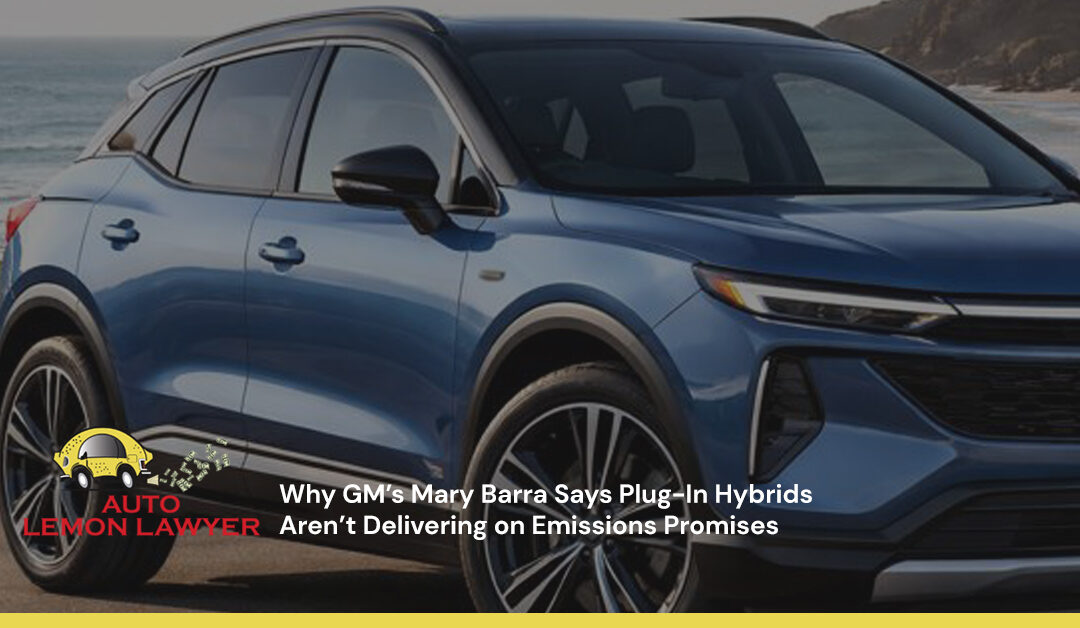
Electric vehicles were once seen as a solution to transportation’s emissions crisis. Plug-in hybrids, in particular, were promoted as a middle ground – combining electric driving with the reliability of gas power. However, new research suggests their environmental benefits may have been overstated, and in some cases, they may actually contribute to higher emissions.
The core issue with plug-in hybrids is surprisingly simple: many drivers don’t actually plug them in. General Motors CEO Mary Barra acknowledged this reality at the Automotive Press Association conference in Detroit, noting that the company is well aware of the limitation. “Most people don’t plug them in,” she said, adding that GM is working to be more deliberate in its approach to both hybrid and plug-in hybrid vehicles.
GM originally introduced hybrid models to encourage wider adoption of more fuel-efficient cars. In 2024, the company announced plans to expand its plug-in hybrid lineup in North America beginning in 2027. However, Barra now says GM is “continuing to evaluate” its hybrid and plug-in strategy, even as the company maintains its long-term focus on fully electric vehicles. “We think that’s the endgame,” she said, referring to EVs.
Hybrid electric vehicles (HEVs) vs. Plug-in hybrid electric vehicles (PHEVs)
There are two main types of hybrid vehicles, and the difference between them is more important than many drivers realize.
Hybrid electric vehicles (HEVs) recharge their batteries through regenerative braking and never need to be plugged in. They rely on a continuous balance between their gas and electric systems to improve fuel efficiency.
Plug-in hybrid electric vehicles (PHEVs), on the other hand, come with larger batteries that can be charged using an external power source, similar to fully electric vehicles. While they also use regenerative braking, it isn’t enough to fully recharge the battery on its own. Without regular charging, much of their electric advantage disappears.
This distinction matters because PHEV drivers can easily choose not to plug in. When that happens, the vehicle operates mostly on its gas engine while still carrying the added weight of a large battery.
According to Consumer Reports, that extra weight can make plug-in hybrids less fuel-efficient than comparable gas-only vehicles.
For example, once the BMW 330e xDrive sedan’s 20-mile electric range is depleted, it achieves just 25 miles per gallon – three mpg less than the conventional 330i xDrive’s EPA rating of 28 mpg. Consumer Reports notes that this drop in efficiency is largely due to the added battery weight, which increases fuel consumption when the vehicle switches to gas power.
As a result, the projected climate benefits of plug-in hybrids can be misleading, giving drivers the impression they are reducing emissions when, in reality, they may be producing more.
Reports Highlight Major Issues With Plug-In Hybrid Vehicles
In October 2025, Transportation & Environment, a European clean-transport advocacy group, released a report describing plug-in hybrids as “a diversion on the road to zero emissions.” The group found that real-world carbon dioxide emissions from these vehicles were nearly five times higher than official estimates.
Similarly, driving data from the European Commission in 2024 showed that plug-in hybrids produced about 3.5 times more carbon dioxide than laboratory tests used for regulatory approval indicated.
In the United States, the International Council on Clean Transportation reported in 2022 that real-world electric driving among plug-in hybrid owners may be 26 to 56 percent lower than assumed under the EPA’s labeling system. At the same time, actual fuel consumption may be 42 to 67 percent higher than projected.
These regulatory models are based on the assumption that roughly 84 percent of PHEV driving occurs on battery power. In reality, research suggests that only about 27 percent of drivers primarily rely on electric mode.
Mary Barra has emphasized that the effectiveness of plug-in hybrids ultimately depends on how consumers use them. Broader market trends suggest that interest in electric vehicles has softened in recent years. EV sales growth is expected to slow further in 2026, following the rollback of federal tax credits and the introduction of new tariffs under the Trump administration. In response, many automakers have leaned more heavily on hybrids as a way to maintain interest in fuel-efficient vehicles.
Electric vehicles remain a critical part of addressing the climate crisis, especially in the United States, the world’s largest cumulative emitter of greenhouse gases. However, when it comes to plug-in hybrids, their environmental benefits only materialize if drivers consistently charge them. Without that commitment, these compromise vehicles may place a greater strain on the environment than traditional gas-powered cars.

Over the past 31+ years, I have been devoted to standing up for consumers, tackling intricate class action consumer litigations, handling complex multi-district cases, and recovering millions of dollars for my Lemon Law clients. Being admitted in District Courts in Louisiana, Texas, California, Michigan, Florida, and Indiana, my practice has led me to represent clients all over the United States in my Lemon Law cases. Regardless of your location, my firm is committed to offering the highest level of professional support, especially in Lemon Law.