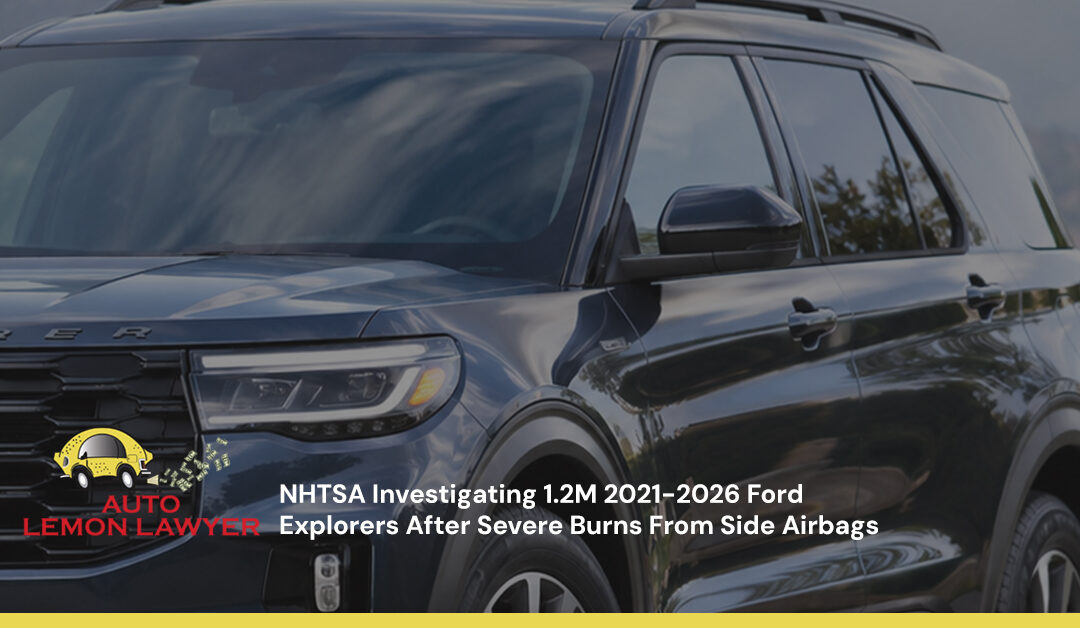
Federal safety regulators have opened an investigation into more than 1.2 million Ford Explorer SUVs after reports that occupants suffered serious burns when seat-mounted side airbags deployed during crashes.
The National Highway Traffic Safety Administration’s Office of Defects Investigation (ODI) opened Preliminary Evaluation PE26008 on November 6, 2026. The investigation covers an estimated 1,236,155 model year 2021 through 2026 Ford Explorers.
According to NHTSA, drivers and front-seat passengers have reported suffering burn injuries following deployment of the seat-mounted side airbags. The reported injuries were typically diagnosed as second- or third-degree burns requiring medical treatment. Some incidents involved law enforcement officers operating Ford Explorer Police Interceptor vehicles.
At this point, however, this is an investigation – not a safety recall. NHTSA is examining the allegations to determine the scope, frequency and potential safety consequences of the reported problem.
Quick Highlights
- NHTSA is investigating an estimated 1,236,155 Ford Explorers from model years 2021 through 2026 over reported burn injuries following side airbag deployment.
- The investigation, identified as PE26008, was opened on November 6, 2026.
- The issue involves the seat-mounted side airbags for front-seat occupants, not all airbags in the Explorer.
- NHTSA has identified 11 distinct reported incidents after eliminating duplicate reports.
- The agency lists 10 reported injuries and no fatalities associated with the investigation.
- Reported injuries have generally involved second- and third-degree burns requiring medical treatment.
- Both drivers and front passengers have allegedly been injured.
- Some complaints involve law enforcement officers in Ford Explorer Police Interceptor vehicles.
- Consumer reports have described hot gases or material from the side airbag reaching occupants during deployment, but NHTSA has not yet announced an official root cause.
- There is currently no recall associated with this particular alleged defect. NHTSA’s preliminary evaluation could be closed without further action, expanded, or ultimately lead to a recall depending on what regulators find.
- Explorer owners who experience airbag problems, warning lights or other recurring safety concerns should have the problem documented by an authorized Ford dealer and retain all repair records.
Which Ford Explorers Are Under Investigation?
NHTSA’s investigation covers:
2021, 2022, 2023, 2024, 2025 and 2026 Ford Explorer vehicles.
The estimated population is 1,236,155 vehicles.
The investigation also encompasses incidents involving Ford Explorer Police Interceptor Utility vehicles, which are widely used by law enforcement agencies.
Importantly, NHTSA’s decision to investigate this population does not mean the agency has concluded that all 1.2 million vehicles contain a defective airbag.
The vehicle count represents the population regulators are examining while they determine whether a safety-related defect exists, how widespread any problem may be and what additional action may be appropriate.
What Is Allegedly Happening With the Ford Explorer Side Airbags?
The reports involve seat-mounted side airbags that deploy during certain crashes to help protect drivers and front-seat passengers.
Instead of only protecting occupants during the collision, however, some consumers allege that deployment resulted in significant burns.
NHTSA’s opening investigation document states that both drivers and front passengers have experienced reported burn injuries, typically diagnosed as second- or third-degree burns requiring medical treatment.
Several consumer reports provide more detail about what occupants say they experienced.
CarComplaints reports that one front passenger involved in a side-impact collision said the deployment produced an immediate burning sensation and that the incident burned through multiple layers of clothing before injuring the person’s skin.
Another Explorer owner alleged that hot material or gas from the seat-mounted side airbag was directed toward the occupant when the airbag deployed, resulting in burns and damaged clothing.
These are consumer allegations and should not be confused with an official determination of the defect’s cause. NHTSA has not yet publicly concluded why the reported burns are occurring.
NHTSA Has Identified 11 Incidents and 10 Injuries
NHTSA’s investigation was prompted by information from multiple sources.
ODI received eight Vehicle Owner Questionnaires, commonly called VOQs, along with four Early Warning Reporting “Death and Injury” reports concerning alleged burns after Explorer side airbag deployments.
After eliminating duplicate reports, NHTSA lists:
11 total incidents, 10 injury incidents, 10 injuries and zero fatalities.
The distinction between 12 incoming reports and 11 incidents is important because NHTSA notes that its total eliminates duplicate reports received through different reporting channels.
While 10 reported injuries represent a small percentage of the approximately 1.2 million vehicles under investigation, the severity of the alleged injuries is significant. Second- and third-degree burns can require substantial medical treatment, which is one reason a potential problem involving a safety device warrants closer federal examination.
Police Officers Are Among Those Reporting Burn Injuries
The investigation is particularly notable because some of the complaints involve law enforcement officers driving Ford Explorer Police Interceptor vehicles.
NHTSA specifically states that some of the Vehicle Owner Questionnaires describe injuries to officers after side airbag deployments in Police Interceptors.
One complaint discussed by CarComplaints involved an officer whose seat-mounted side airbag deployed during a collision. The report alleged that heat from the deployment damaged or melted components on the officer’s utility belt, which the complainant believed may have helped shield the officer from more extensive burns.
Police vehicles can present unique occupant considerations because officers may be wearing utility belts, body armor and other equipment while seated.
At this stage, however, the federal investigation encompasses both civilian Ford Explorers and incidents involving Police Interceptor versions.
What Causes an Airbag to Burn Someone?
Airbags deploy extremely quickly using an inflator that produces gas to fill the airbag cushion in a fraction of a second.
Some heat can be generated during normal airbag deployment, and abrasions or minor injuries from an airbag are possible during a serious collision.
But the injuries described in NHTSA’s investigation are more substantial.
Consumers have alleged second- and third-degree burns, including injuries they attribute to hot gas or material released during deployment.
NHTSA has not yet announced what is causing the reported injuries.
Determining the actual mechanism behind the complaints is one purpose of the investigation. Investigators may examine airbag components, design specifications, crash data, consumer complaints, manufacturer records and other technical information before deciding whether a defect exists.
It would therefore be premature to conclude that the inflator, vent placement, propellant or another specific component is responsible until regulators complete additional analysis.
What Is a NHTSA Preliminary Evaluation?
A Preliminary Evaluation is an early stage in NHTSA’s defect investigation process.
NHTSA says it opened PE26008 specifically to evaluate the scope, frequency and potential safety-related consequences of the alleged Ford Explorer airbag defect.
The agency can request additional information from Ford, examine complaints and manufacturer data, analyze affected components and evaluate whether the incidents reveal a pattern.
A preliminary investigation does not automatically result in a recall.
NHTSA explains that investigations can ultimately be closed if regulators do not identify a safety-related defect, while evidence of a defect may result in further investigation or recall action.
That distinction is important for owners who may see headlines stating that 1.2 million Explorers are “affected.”
At this time, 1.2 million Explorers are under investigation. They have not all been recalled because of this side-airbag issue.
Has Ford Recalled the 2021-2026 Explorer for This Airbag Problem?
Not as of November 16, 2026.
The federal action currently identified as PE26008 is a Preliminary Evaluation, not a recall campaign.
NHTSA has not announced a recall remedy, and owners have not been instructed to bring all 2021-2026 Explorers to dealerships to replace the side airbags based on this investigation.
That could change.
If NHTSA’s investigation finds evidence of an unreasonable safety risk, Ford could voluntarily initiate a recall, or federal regulators could pursue further steps intended to compel corrective action.
On the other hand, NHTSA could determine that no broader safety defect exists and close the investigation without a recall.
Auto Lemon Lawyer similarly explains that a NHTSA investigation and a vehicle recall are not the same thing. NHTSA may examine consumer complaints, crash reports, warranty information and technical data before determining whether additional action is necessary.
What Should 2021-2026 Ford Explorer Owners Do?
Owners do not need to assume their Explorer has a defective side airbag simply because it falls within one of the model years being investigated.
However, owners should remain aware of the investigation and make sure their contact information with Ford is current so they can receive future safety notices if a recall is eventually announced.
Owners can also periodically search their VIN through NHTSA’s recall website. NHTSA notes that recently announced recalls may not immediately show every affected VIN, so owners concerned about a developing safety issue should check periodically.
If an Explorer displays an airbag or Supplemental Restraint System warning, an owner should have the vehicle inspected rather than simply clearing or ignoring the warning.
Owners who have already experienced an airbag deployment followed by an unusual burn injury should consider reporting the incident to NHTSA as well. Consumer complaints play an important role in helping federal regulators identify possible safety-defect patterns.
Why Filing a NHTSA Complaint Can Matter
NHTSA’s investigation into the Explorer demonstrates how individual consumer complaints can contribute to a broader federal safety review.
The agency explains that vehicle-owner complaints are entered into its public database after personally identifying information is removed. When regulators identify similar complaints involving the same vehicle or component, those reports may help reveal a potential defect worthy of investigation.
When submitting a complaint, owners should provide as much useful factual information as possible, including the vehicle year, model and mileage, when the incident happened, which airbag deployed, where the occupant was seated, what injuries occurred and whether the vehicle was inspected afterward.
Medical documentation, photographs of injuries or damaged clothing, photographs of the vehicle interior and dealership records may also be useful to preserve independently.
What If Your Ford Explorer Has Other Airbag or Safety Problems?
The existence of a federal investigation does not replace the importance of creating a repair history for an individual vehicle.
If your Explorer experiences an airbag warning light, restraint-system malfunction, unexpected warning message or another suspected safety defect, take it to an authorized Ford dealership while the vehicle remains under warranty whenever possible.
Make sure the repair order accurately describes the complaint.
For example, if an airbag warning appears repeatedly, the repair order should document that recurring airbag warning rather than simply saying “customer requests inspection.”
If the dealership says it cannot duplicate the problem, keep the repair order anyway.
Auto Lemon Lawyer notes that intermittent vehicle defects may not always produce diagnostic trouble codes or occur while a technician is driving the vehicle. Multiple documented repair attempts can still become important when determining whether an ongoing warranty defect exists.
Does the Ford Explorer Airbag Investigation Mean Your Vehicle Is a Lemon?
No.
A NHTSA investigation by itself does not mean that every Ford Explorer included in the investigation legally qualifies as a lemon.
Likewise, even if this investigation eventually results in a recall, the existence of a recall alone generally does not establish an individual Lemon Law claim.
Those claims depend heavily on the circumstances surrounding the particular vehicle.
Relevant factors may include the nature and severity of the defect, whether it is covered by warranty, how many times the manufacturer or authorized dealership has attempted to repair it, how much time the vehicle has spent out of service and whether the problem substantially affects the vehicle’s use, value or safety.
The requirements also vary significantly from one state to another.
Auto Lemon Lawyer notes that vehicles with repeated failures, extensive repair histories, serious safety concerns and significant time out of service may present stronger potential warranty claims than vehicles where an isolated problem is successfully repaired.
Why Documentation Matters for Ford Explorer Owners
The federal investigation itself may eventually produce valuable information about whether a widespread defect exists.
But for an individual owner considering a warranty or Lemon Law claim, the vehicle’s own repair history can be just as important.
An Explorer owner should preserve dealership repair orders, dates and mileage from each visit, photographs of dashboard warnings, communications with Ford, towing records and information showing how long the vehicle was unavailable because of repairs.
If a problem returns after the dealership says it has been fixed, bring the Explorer back and have the recurring concern documented again.
Auto Lemon Lawyer’s guidance on previous vehicle recalls similarly emphasizes that repair records can demonstrate when a problem began, how frequently it occurred, how many opportunities the manufacturer received to fix it, whether previous repairs worked and how significantly the defect affected the vehicle’s use, value or safety.
Having Repeated Airbag or Safety Problems With Your Ford Explorer?
NHTSA’s new investigation raises serious questions because an airbag is designed to reduce injury during a collision—not create an additional risk of severe burns.
For now, regulators are still determining what happened in the reported incidents and whether a broader safety defect exists in 2021-2026 Ford Explorers.
No recall has yet been announced for this specific issue, and NHTSA’s investigation should not be interpreted as a finding that every Explorer within the 1.2-million-vehicle population is defective.
But Explorer owners who have experienced repeated airbag warnings, restraint-system problems, unsuccessful warranty repairs, recurring safety defects or substantial time in the repair shop should continue documenting every problem.
An ongoing federal investigation may provide useful evidence about a potential widespread issue, but an owner’s individual repair history remains critical when evaluating rights under state Lemon Laws and federal warranty law.
If your Ford Explorer has been repeatedly repaired for the same problem or continues experiencing unresolved safety or warranty defects, contact Auto Lemon Lawyer for a free case evaluation.

Lucas graduated cum laude from Southern University Law Center in 2025, finishing second overall in his graduating cohort. He was a recipient of the Southern University Law Center Merit Scholarship, awarded to students in the top five percent (5%) of the class based on merit, academic performance, and character. Lucas is admitted to practice law in the State of Louisiana. While his time in formal legal practice is recent, he has been part of the Auto Lemon Lawyer team for over five years, during which he has worked in every position within the firm. This experience provides him with a comprehensive understanding of Lemon Law cases from intake through litigation and resolution.