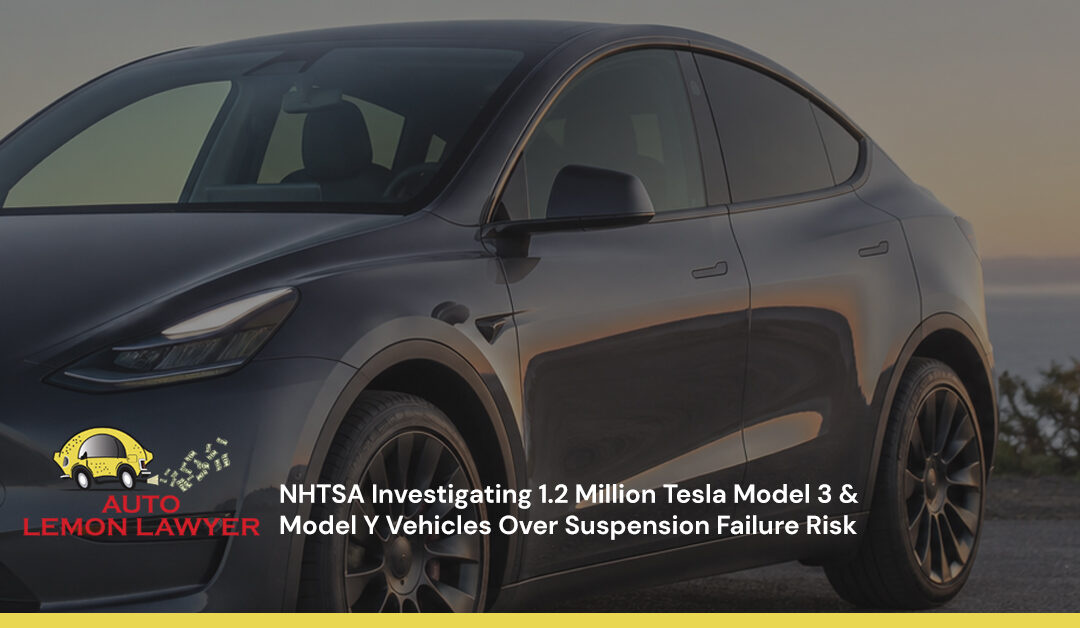
Federal safety regulators have opened an investigation into nearly 1.2 million Tesla Model 3 and Model Y vehicles following reports that a critical front suspension component may detach without warning.
The National Highway Traffic Safety Administration’s Office of Defects Investigation opened Preliminary Evaluation PE26006 on July 29, 2026. The investigation covers an estimated 1,198,300 Tesla vehicles and centers on the possible detachment of the front lower lateral link, which could cause drivers to lose directional control.
Although no recall has been announced yet, Tesla owners should understand which vehicles are included, what symptoms have been reported, and what steps to take if their vehicle develops steering or suspension problems.
Quick Takeaways
- NHTSA is investigating approximately 1.2 million Tesla vehicles for a possible front suspension defect.
- The investigation covers 2018–2020 Tesla Model 3 vehicles and 2021–2023 Tesla Model Y vehicles.
- Regulators have received 156 complaints involving alleged detachment of the front lower lateral link.
- The reported failure may cause a loss of directional control and leave the vehicle unable to be driven.
- Most owners reportedly received no advance warning, although some heard unusual noises before the failure.
- NHTSA had not identified any related crashes, injuries, or fatalities when it opened the investigation.
- This is currently an investigation – not a recall – but it could lead to additional action if regulators identify a safety defect.
Which Tesla Vehicles Are Under Investigation?
NHTSA’s investigation applies to the following vehicles:
| Tesla model | Model years under investigation |
| Tesla Model 3 | 2018–2020 |
| Tesla Model Y | 2021–2023 |
The estimated population is 1,198,300 vehicles. Owners should remember that an investigation does not necessarily mean every vehicle within these model years contains a defective part. It means regulators are examining whether the complaints indicate a broader safety-related problem.
NHTSA’s investigation is identified as PE26006 and was prompted by a review of Vehicle Owner Questionnaires, commonly known as consumer complaints.
What Suspension Problem Is NHTSA Investigating?
The investigation focuses on the front lower lateral link, a mechanical suspension component that helps maintain the position and alignment of the front wheel as the vehicle turns and travels over the road.
NHTSA says it received 156 complaints alleging that this link detached. When the component separates, the vehicle may lose directional control. The vehicle may also become undrivable and require towing.
A suspension failure of this nature is especially concerning because it is not simply a matter of reduced ride comfort. The suspension and steering systems work together to keep the wheels properly positioned and allow the driver to control the vehicle’s direction. A major component detachment could make it difficult or impossible to steer normally.
Some reports have described wheels or related suspension components becoming visibly displaced after the failure. One Model Y owner alleged that a front wheel partially detached without warning, resulting in an immediate loss of steering control.
Owners Reported Few or No Warning Signs
One of the most troubling aspects of the investigation is the alleged lack of warning before the component fails.
According to NHTSA, most complaints indicated there was no advance warning that the suspension failure was about to occur. Some owners reported hearing noises beforehand, but the vehicles reportedly did not provide dashboard alerts or other visual warnings.
Possible symptoms reported in connection with the complaints include:
- Creaking or squeaking while turning
- Knocking or clunking from the front suspension
- Unusual noises during low-speed maneuvers
- Changes in steering response
- A wheel appearing out of alignment or improperly positioned
- A sudden loss of directional control
- The vehicle becoming undrivable
These symptoms can have multiple causes and do not automatically prove that a lateral link is detaching. Nevertheless, Tesla owners should not ignore new steering or suspension noises, particularly when accompanied by pulling, instability, uneven wheel positioning, or changes in handling.
Have Any Crashes or Injuries Been Reported?
NHTSA’s opening report listed:
- 156 total incidents
- Zero reported crashes or fires
- Zero reported injury incidents
- Zero reported fatalities
Those figures reflect the information available to NHTSA when the preliminary evaluation was opened.
The absence of reported injuries does not eliminate the potential safety concern. The purpose of the investigation is to determine the underlying cause, scope, and severity of the alleged defect before more serious incidents occur.
Tesla Previously Recalled Model 3 Vehicles for Lateral Link Problems
This is not the first federal safety action involving lateral link detachments in Tesla vehicles. NHTSA’s investigation notice references two previous recalls:
Recall 21V-835
This recall covered 2,791 model-year 2019–2021 Tesla Model 3 vehicles. It addressed a production issue that could allow a lateral link to separate from the subframe.
Recall 23V-235
This later recall covered 422 model-year 2018–2019 Model 3 vehicles that had experienced failures similar to those addressed by Recall 21V-835.
However, NHTSA says the incidents included in the new investigation extend beyond the scope of those recalls and do not appear to be related to the production problem that prompted the earlier actions.
That distinction will be an important part of the investigation. Regulators will seek to determine whether the recent complaints involve a different manufacturing problem, a component durability concern, an assembly issue, a design defect, or another cause.
Does the Investigation Mean There Is a Tesla Recall?
No. As of August 5, 2026, NHTSA has opened a preliminary evaluation, not a recall.
A preliminary evaluation is an early stage in NHTSA’s defect-investigation process. Investigators may gather complaints, warranty information, field reports, repair data, engineering records, and other information from the manufacturer.
Possible outcomes include:
- Closing the investigation without further action
- Expanding the investigation for additional analysis
- Tesla initiating a voluntary recall
- NHTSA seeking a recall if it determines that a safety-related defect exists
The investigation will examine the cause, frequency, scope, and potential safety consequences of the reported failures.
Owners should therefore be cautious about social media posts or headlines claiming that all affected vehicles have already been recalled. A formal recall would include a defined vehicle population, an official remedy, and owner-notification instructions.
What Should Model 3 and Model Y Owners Do?
Owners of potentially affected vehicles can take several practical steps while the investigation remains open.
Pay attention to suspension and steering symptoms
Do not dismiss new creaking, clunking, knocking, pulling, looseness, vibration, or changes in steering response. Arrange for the vehicle to be inspected promptly.
Avoid driving a vehicle that feels unsafe
When a wheel appears displaced or the vehicle becomes difficult to steer, stop in a safe location and arrange for towing. Continuing to drive could worsen the damage or increase the risk of losing control.
Request a written inspection
Bring the vehicle to an authorized Tesla service location and clearly describe every symptom. Ask that your concerns be included on the repair order even when technicians cannot duplicate the problem.
Keep all documentation
Save repair orders, service estimates, invoices, photographs, videos, towing receipts, messages exchanged with Tesla, and records showing how long the vehicle was unavailable.
Repair records, purchase documents, the number of repair attempts, defect severity, and days out of service may all be important when evaluating a warranty or lemon law claim. An intermittent defect or a problem that does not generate an error code should still be documented.
Check your VIN for recalls
Vehicle owners can use NHTSA’s recall-search system to check whether an existing recall applies to their specific VIN. Remember that the current investigation may include vehicles that were not covered by Tesla’s earlier suspension recalls.
Report the problem to NHTSA
Owners who experience a suspected suspension failure can submit a vehicle safety complaint to NHTSA. Consumer complaints can help regulators identify patterns and determine whether further action is needed.
Could Repeated Tesla Suspension Problems Support a Lemon Law Claim?
A federal investigation or recall may help establish that other owners have reported similar problems, but it does not automatically make an individual vehicle a lemon. Likewise, owners do not necessarily need to wait for a recall before exploring their warranty rights.
The strength of a potential claim may depend on factors such as:
- Whether the vehicle was covered by a manufacturer’s warranty
- The number of repair attempts
- Whether Tesla was given reasonable opportunities to repair the problem
- The seriousness of the safety concern
- Whether the defect continues after repairs
- How many days the vehicle spent out of service
- The vehicle’s age, mileage, purchase circumstances, and state of purchase
- The applicable state and federal warranty laws
Repeated suspension failures, unsuccessful repairs, extended time in the shop, or a defect that substantially affects safe operation may warrant a legal review. Auto Lemon Lawyer explains that an authorized dealer’s inability to duplicate an intermittent concern does not necessarily eliminate a case, especially when the owner has made multiple documented repair attempts.
Speak With Auto Lemon Lawyer About Your Tesla Problems
A Tesla owner should not have to repeatedly return to a service center for serious suspension or steering problems without receiving a lasting repair.
When your Model 3 or Model Y has experienced repeated suspension failures, unsuccessful warranty repairs, extended downtime, or continued safety concerns, Auto Lemon Lawyer can review the vehicle’s history and explain the options that may be available under applicable warranty laws.
Contact Auto Lemon Lawyer to have your Tesla repair history reviewed and determine whether you may have a warranty or lemon law claim.

Lucas graduated cum laude from Southern University Law Center in 2025, finishing second overall in his graduating cohort. He was a recipient of the Southern University Law Center Merit Scholarship, awarded to students in the top five percent (5%) of the class based on merit, academic performance, and character. Lucas is admitted to practice law in the State of Louisiana. While his time in formal legal practice is recent, he has been part of the Auto Lemon Lawyer team for over five years, during which he has worked in every position within the firm. This experience provides him with a comprehensive understanding of Lemon Law cases from intake through litigation and resolution.