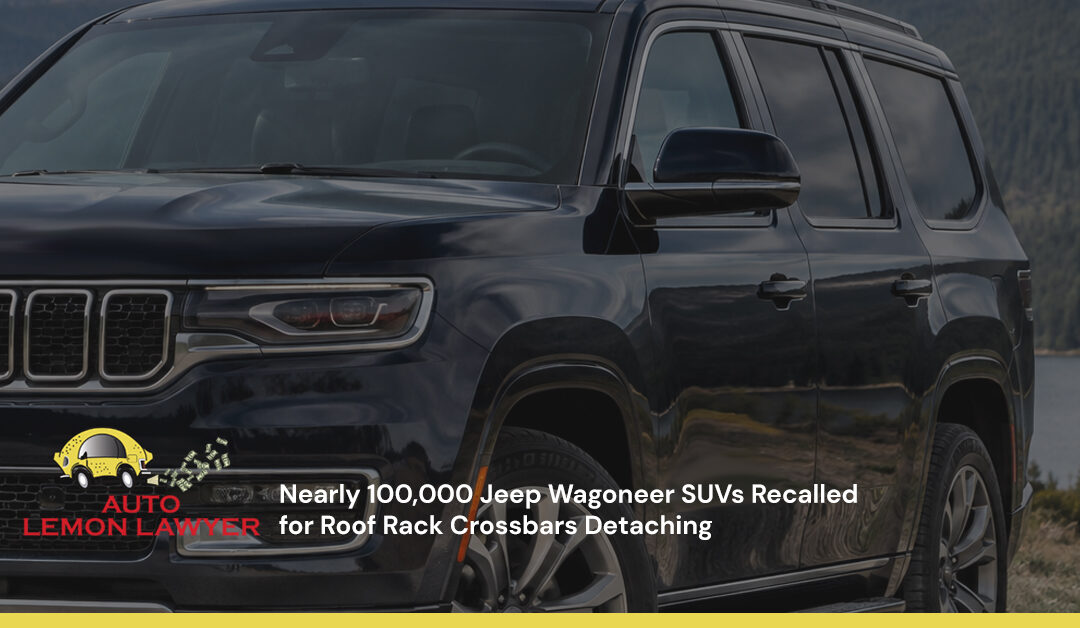
Jeep is recalling 97,349 Wagoneer and Grand Wagoneer SUVs in the United States because improperly tightened bolts may allow the vehicles’ roof rack crossbars to detach while driving.
According to documents filed by FCA US LLC with the National Highway Traffic Safety Administration (NHTSA), the pivot bolts securing certain roof rack crossbars may have been installed with insufficient torque. If a crossbar separates from the SUV while it is moving, it could become a roadway hazard and potentially cause another vehicle to crash.
The recall spans several model years of the Jeep Wagoneer, Wagoneer L, Grand Wagoneer and Grand Wagoneer L. FCA says owners may notice warning signs such as a rattling noise or a missing bolt before a crossbar completely detaches. As of August 31, 2026, the automaker reported 15 potentially related warranty claims but said it was not aware of any associated accidents or injuries.
Quick Highlights
- 97,349 Jeep Wagoneer-family SUVs are included in NHTSA Recall 26V584, also identified by FCA as Recall 81D.
- Affected vehicles include certain 2022–2025 Jeep Wagoneer, 2022–2026 Grand Wagoneer, 2023–2025 Wagoneer L and 2023–2026 Grand Wagoneer L SUVs.
- The roof rack crossbar pivot bolts may not have been tightened properly.
- An improperly secured crossbar could detach from the vehicle and become a road hazard.
- Possible warning signs include rattling from the roof rack, a missing bolt or separation at a crossbar pivot joint.
- FCA had identified 15 potentially related warranty claims as of August 31, 2026, but reported no known accidents or injuries linked to the issue.
- Dealers will repair the roof crossbar pivot joints using newly designed bolts at no charge.
- Interim owner notification letters are expected to begin going out around October 8, 2026.
Which Jeep Wagoneer and Grand Wagoneer Models Are Recalled?
The recall involves four members of Jeep’s full-size Wagoneer family:
| Model | Model Years | Vehicles Potentially Affected |
| Jeep Wagoneer | 2022–2025 | 54,249 |
| Jeep Grand Wagoneer | 2022–2026 | 22,144 |
| Jeep Wagoneer L | 2023–2025 | 11,606 |
| Jeep Grand Wagoneer L | 2023–2026 | 9,350 |
| Total | 97,349 |
FCA determined the affected population using supplier and vehicle production records. Vehicles manufactured outside the suspect production periods or vehicles that were not equipped with the affected roof crossbars are not included.
Because inclusion in a safety recall depends on the specific vehicle identification number (VIN), owning a Wagoneer from one of the listed model years does not necessarily mean that a particular SUV is affected.
What Is Wrong With the Jeep Wagoneer Roof Rack?
According to FCA’s Part 573 safety recall filing, some crossbars may have been assembled with pivot bolts that did not receive sufficient torque. If a bolt becomes loose enough, the crossbar can separate from the vehicle.
A roof crossbar coming loose is more serious than simply losing an accessory. A detached component can fall into the roadway while the SUV is traveling, creating a sudden obstacle for motorists behind or alongside the Jeep.
NHTSA’s recall documentation specifically warns that a detached crossbar may create a road hazard for occupants and operators of other vehicles and could result in a crash without advance warning.
FCA estimates that 100% of the 97,349 vehicles in the recall population contain the potentially defective condition. That estimate does not mean every roof rack will necessarily detach; it means the automaker considers the entire recalled population potentially affected by the improperly secured hardware.
Are There Warning Signs Before a Roof Crossbar Detaches?
There may be. FCA says owners could notice several signs that something is wrong with the roof rack before the crossbar completely separates. These include:
- A rattling noise coming from the roof rack;
- A visibly missing crossbar bolt; or
- A crossbar that appears to be coming apart at the pivot joint.
Owners who notice unusual movement, rattling or visible separation involving a roof crossbar should avoid ignoring the problem simply because the rack still appears attached.
If you bring your Jeep to a dealership because of a suspected roof rack problem, make sure the specific symptoms you reported are documented on the repair order.
How Did FCA Discover the Problem?
FCA’s Technical Safety and Regulatory Compliance organization opened an investigation into the issue on June 25, 2026.
Between June and August, FCA worked with its engineering and manufacturing teams to review production records, changes to the crossbar design and the possible consequences if the component detached.
As of August 31, FCA said it was aware of 15 warranty claims potentially associated with the condition, dating from May 2023 through May 2026. The automaker reported no related customer assistance records or field reports and said it was not aware of any accidents or injuries potentially connected with the defect.
On September 3, 2026, FCA’s Vehicle Regulations Committee determined that a safety defect existed in certain vehicles, leading to the recall.
How Will Jeep Fix the Recalled Wagoneers?
FCA plans to repair the affected roof rack pivot joints using newly designed pivot bolts.
NHTSA says dealers will replace the affected roof rack crossbar pivot bolts free of charge.
However, the repair campaign will be conducted in phases. FCA plans to send interim notification letters to affected owners beginning around October 8, 2026. A second notification will be issued once the final remedy is available for owners to have the repair performed.
Jeep dealers were scheduled to be notified of the recall beginning September 17.
How Can Jeep Owners Determine if Their SUV Is Recalled?
VINs associated with Recall 81D became searchable beginning September 17, 2026, according to FCA’s NHTSA filing.
Owners can check their individual VIN through NHTSA’s recall lookup system. NHTSA allows consumers to search by VIN to determine whether a vehicle has an unrepaired safety recall.
Affected owners may also contact Chrysler customer service at 1-800-853-1403 and reference Recall 81D. The corresponding NHTSA campaign number is 26V584.
More Than 3,000 Mopar Roof Rack Kits Are Also Being Recalled
The problem is not limited to crossbars installed on vehicles within the 97,349-vehicle recall.
FCA has also initiated a separate equipment recall involving approximately 3,038 Mopar roof rack kits that may contain the same type of improperly secured pivot bolts. Several different Mopar crossbar part numbers are affected.
Owners who purchased or installed a Mopar roof rack separately may therefore want to confirm whether their equipment is affected even if their vehicle itself does not appear in the main vehicle recall.
What Should Owners of Recalled Jeep Wagoneers Do?
If you own a Wagoneer, Wagoneer L, Grand Wagoneer or Grand Wagoneer L from one of the affected model years, start by checking your VIN rather than assuming the recall applies to every vehicle from that model year.
Owners whose SUVs are included should also keep records related to the recall and any roof rack problems they have experienced. Helpful documentation can include recall letters, dealership repair orders, photographs or video of a loose crossbar, dates when rattling or movement occurred, and communications with Jeep or the dealership.
If you previously brought the vehicle to a dealer because the roof rack was loose, noisy or separating, retain those earlier service records as well.
And after the recall repair is performed, continue to pay attention to the roof rack. If the same condition returns or the repair does not resolve the problem, make sure the vehicle is brought back to the dealership and the continuing complaint is documented.
Does the Jeep Wagoneer Roof Rack Recall Mean Your SUV Is a Lemon?
A recall alone does not automatically mean that a Jeep Wagoneer qualifies as a lemon.
Manufacturers are generally given an opportunity to repair warranty-covered defects, including defects that later become the subject of a safety recall.
A recall may become more relevant to a potential Lemon Law or warranty claim when an owner experiences an ongoing problem that the manufacturer or dealership cannot successfully correct. Auto Lemon Lawyer notes that repeated repair attempts, significant time out of service, safety-related defects, recalls and detailed service documentation can all be important factors when evaluating a potential warranty claim.
For example, an owner may want to investigate their legal options if:
- The roof rack continues becoming loose after repairs;
- A dealer makes multiple unsuccessful attempts to correct the same problem;
- Replacement parts or a recall remedy are unavailable for an extended period;
- The vehicle spends significant time at the dealership;
- A recalled condition returns after the recall work is completed; or
- The Wagoneer has additional recurring warranty problems beyond the roof rack.
Lemon Law requirements vary by state and depend heavily on the vehicle’s warranty status, repair history and individual circumstances.
Having Repeated Problems With Your Jeep Wagoneer?
The new roof rack recall is intended to prevent affected crossbars from separating from Jeep Wagoneer and Grand Wagoneer SUVs. For many owners, replacing the pivot bolts may resolve the issue.
But if your Wagoneer or Grand Wagoneer has experienced repeated roof rack problems, unsuccessful repairs, excessive time in the shop or other recurring warranty defects, the recall may be only one part of your vehicle’s repair history.
Auto Lemon Lawyer can review your service records and help determine whether your Jeep may qualify for protection under applicable Lemon Law or vehicle warranty laws.
Contact Auto Lemon Lawyer today for a free case evaluation.

Lucas graduated cum laude from Southern University Law Center in 2025, finishing second overall in his graduating cohort. He was a recipient of the Southern University Law Center Merit Scholarship, awarded to students in the top five percent (5%) of the class based on merit, academic performance, and character. Lucas is admitted to practice law in the State of Louisiana. While his time in formal legal practice is recent, he has been part of the Auto Lemon Lawyer team for over five years, during which he has worked in every position within the firm. This experience provides him with a comprehensive understanding of Lemon Law cases from intake through litigation and resolution.