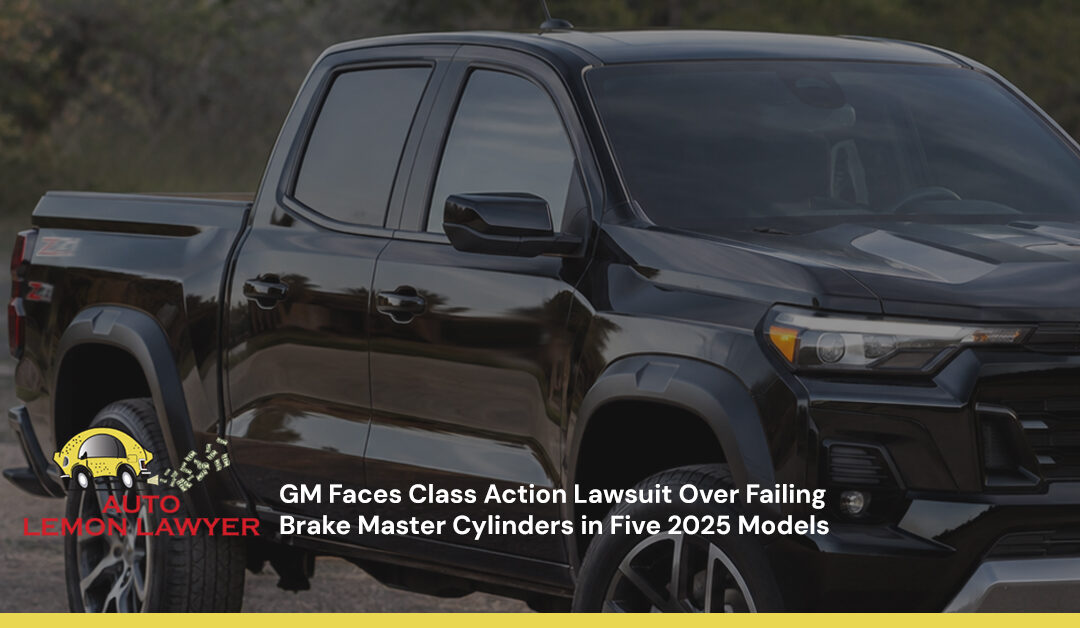
General Motors is facing a proposed class action lawsuit alleging that brake master cylinders installed in five popular 2025 Chevrolet, GMC and Buick models can fail prematurely, potentially resulting in a partial or complete loss of braking ability.
The lawsuit, Fehrmann, et al. v. General Motors LLC, was filed on October 6, 2026, in the U.S. District Court for the Eastern District of Pennsylvania. Six vehicle owners allege that defective internal components within the master brake cylinder assemblies can fail unexpectedly, causing drivers to experience a hard brake pedal, a pedal that sinks toward the floor, warning messages and severely reduced braking performance.
The allegations have not been proven in court, and no class has been certified. However, the litigation comes amid broader scrutiny of braking problems in newer GM vehicles, including a separate federal investigation into GM’s electronic brake boost system.
Quick Highlights
- A proposed class action lawsuit alleges that brake master cylinder assemblies in five 2025 GM models can fail prematurely and cause partial or complete loss of braking.
- The vehicles named in the lawsuit are the 2025 Chevrolet Traverse, 2025 GMC Acadia, 2025 Buick Enclave, 2025 Chevrolet Colorado and 2025 GMC Canyon.
- Plaintiffs allege internal seals or related components can fail, allowing brake fluid to bypass or leak and causing a loss of hydraulic pressure.
- Reported symptoms allegedly include a hard brake pedal, a brake pedal that sinks toward the floor, a red Brake warning light, an ABS warning light and a “Service Brake System” message.
- GM previously issued Service Update N242482170 concerning brake master cylinders in certain 2024 Chevrolet Traverse and 2025 Buick Enclave vehicles.
- GM’s official service update states that certain covered vehicles may have a missing internal cartridge seal in the eBoost module and instructs dealers to replace the brake master cylinder.
- The new lawsuit alleges GM knew of the broader master-cylinder problem but failed to adequately disclose or remedy it.
- The lawsuit is a proposed class action. The allegations have not been proven, no class has yet been certified and there is currently no class-action settlement.
- NHTSA is separately investigating GM’s eBoost braking system, but that investigation concerns a potentially different failure mechanism and should not be confused with the master-cylinder defect alleged in this lawsuit.
- Owners experiencing repeated brake failures, unsuccessful warranty repairs or extended dealership downtime should keep detailed repair records because those factors can be important when evaluating a potential Lemon Law or warranty claim.
Which 2025 GM Vehicles Are Named in the Lawsuit?
The lawsuit identifies five 2025 model-year GM vehicles:
| Make | Model |
| Chevrolet | 2025 Traverse |
| Chevrolet | 2025 Colorado |
| GMC | 2025 Acadia |
| GMC | 2025 Canyon |
| Buick | 2025 Enclave |
The new case was brought by six owners. Five purchased Chevrolet Traverse SUVs, while one purchased a GMC Acadia. The proposed classes seek to represent certain buyers and lessees in Illinois, Kentucky, Michigan, Ohio and Texas.
Importantly, the fact that a vehicle model appears in the lawsuit does not establish that every vehicle of that model contains a defective master cylinder.
The plaintiffs are asking the court to certify classes of owners and lessees, but as of November 2026, no class has been certified and the court has not determined that these vehicles are defective.
What Does the GM Brake Master Cylinder Lawsuit Allege?
At the center of the lawsuit is the brake master cylinder, a critical component of a vehicle’s hydraulic braking system.
When a driver presses the brake pedal, the master cylinder converts that input into hydraulic pressure. That pressure is then used to engage the brakes and slow or stop the vehicle.
The plaintiffs allege that the master cylinder assemblies in the affected GM vehicles contain internal seals and related components that can fail prematurely. According to the complaint, a failure can allow brake fluid to bypass or leak internally, reducing the hydraulic pressure required for normal braking.
The lawsuit claims that these failures may occur suddenly, sometimes only weeks or months after a vehicle is delivered.
According to the plaintiffs, drivers experiencing the alleged defect may notice:
- A brake pedal that becomes unusually hard or difficult to press;
- A brake pedal that sinks toward the floor;
- Reduced braking power;
- Partial or complete loss of braking ability;
- A red Brake warning light;
- An ABS warning light; and
- A “Service Brake System” message.
The original Barron complaint involving the same alleged defect states that owners have also reported attempting to restore braking by restarting their vehicles or repeatedly pumping the brake pedal.
These are allegations made by vehicle owners and plaintiffs in pending litigation. A court has not yet determined that the alleged master-cylinder defect exists across all of the vehicles identified in the lawsuits.
GM Previously Issued a Service Update for Brake Master Cylinders
The lawsuit points heavily to an earlier GM service campaign as evidence that the automaker was already aware of certain brake master cylinder problems.
On December 9, 2024, General Motors issued Service Update N242482170, titled “Brake Master Cylinder.”
The official GM bulletin applied to certain:
- 2025 Buick Enclave vehicles; and
- 2024 Chevrolet Traverse vehicles.
The service update states that certain affected vehicles may have a condition in which the internal cartridge seal in the eBoost module is missing.
GM’s prescribed correction was straightforward: dealers were instructed to replace the brake master cylinder.
The bulletin also instructed dealers to hold covered vehicles in their possession and complete the service update before releasing them to customers when the field action applied.
The service campaign is important to the class action because plaintiffs argue it demonstrates GM was aware of problems involving brake master cylinder assemblies before many 2025 vehicles were sold.
However, GM’s service update itself does not state that all five 2025 models named in the lawsuit contain the same defect.
Plaintiffs Claim GM Knew About the Problem Before Vehicles Were Sold
One of the central allegations in the lawsuit is that GM knew or should have known about the alleged brake defect but did not sufficiently disclose it to consumers.
The plaintiffs cite several alleged sources of knowledge, including pre-production testing, warranty data, dealership reports, consumer complaints and replacement-part orders.
They also point to the December 2024 service update involving the 2024 Traverse and 2025 Enclave.
The complaint alleges that substantially similar brake master cylinder assemblies were installed in additional 2025 GM models and that reports of premature failures should have alerted the manufacturer to a broader issue.
GM’s knowledge and the extent to which the same alleged defect exists across the five vehicles remain contested issues in the litigation. These allegations have not yet been established by a court.
Owners Have Reported Low-Mileage Brake Problems
The earlier Barron v. General Motors LLC complaint cited multiple complaints submitted to NHTSA by GM owners.
For example, the complaint references a 2025 Chevrolet Traverse owner who reported that the vehicle’s brake system failed only about three weeks after purchase. The dealer allegedly diagnosed a bad master cylinder, but the replacement part was reportedly backordered.
Another 2025 Traverse owner reported a master cylinder problem at approximately 1,200 miles, according to the complaint.
The lawsuit also cites a 2025 GMC Acadia owner who reported a master cylinder failure at approximately 4,900 miles and said the vehicle remained at the dealership for more than a month while awaiting parts.
Consumer complaints are not independently verified findings that a defect exists. However, recurring complaints can attract attention from manufacturers, regulators and attorneys investigating whether there may be a broader pattern.
This Is Not the First GM Master Cylinder Lawsuit
The October 2026 Fehrmann lawsuit follows an earlier proposed class action involving the same five GM models.
Barron v. General Motors LLC was initially filed in October 2025 in the same federal district court.
The original complaint involved owners of a Chevrolet Traverse and alleged similar failures involving the brake master cylinder. The litigation was later amended to include another plaintiff and claims involving additional states. That case remains pending.
The newer Fehrmann lawsuit was filed on October 6, 2026, by six additional owners.
Together, the lawsuits raise similar questions about whether the master cylinder assemblies installed in these 2025 vehicles are prone to premature failure and whether GM knew about the alleged condition before selling the vehicles.
Again, these remain allegations. Neither lawsuit has resulted in a final court finding that all of the named vehicles are defective.
Is There a Recall for the Alleged Master Cylinder Defect?
As of November 2026, GM has not issued a broad federal safety recall covering the alleged master-cylinder defect across all five 2025 models named in the lawsuit.
That distinction matters.
A manufacturer service update, technical service bulletin and federal safety recall are not the same thing.
GM’s December 2024 Service Update N242482170 applied only to specified VINs involving certain 2024 Chevrolet Traverse and 2025 Buick Enclave vehicles. Owners should not assume that the service campaign automatically applies to their vehicle based solely on the model name.
Owners can ask an authorized GM dealer to check their VIN for outstanding recalls, service campaigns or other applicable field actions.
They can also search their VIN through NHTSA’s recall database.
Auto Lemon Lawyer notes that serious vehicle defects do not necessarily result in an immediate federal recall, and the absence of a recall does not by itself establish that an individual owner’s vehicle is free from a defect.
NHTSA Is Also Investigating GM’s eBoost Braking System
Adding another layer to the story, the National Highway Traffic Safety Administration is conducting a separate investigation involving the eBoost electronic braking system used in many GM vehicles.
In August 2026, NHTSA’s Office of Defects Investigation expanded its investigation into an Engineering Analysis identified as EA26006.
The investigation encompasses more than 1 million vehicles equipped with the system, including model years of the Chevrolet Traverse and Colorado, GMC Acadia and Canyon, and Buick Enclave.
But owners should understand that the NHTSA investigation and the class action lawsuit are not necessarily investigating the same defect.
NHTSA’s engineering analysis is focused largely on reports involving failures within the eBoost system, including potential spindle fractures that may result in a loss of brake assist.
The class action, meanwhile, alleges premature failure of the master brake cylinder’s internal seals and related components, leading to loss of hydraulic pressure.
The Brake Report specifically notes that the NHTSA probe concerns a different potential failure mechanism from the master-cylinder seal problem alleged by plaintiffs.
The overlap in affected models makes the federal investigation noteworthy, but the two issues should not be conflated.
What Should Owners Do If Their Brakes Begin Failing?
Brake problems should always be taken seriously.
If a driver notices that the brake pedal suddenly becomes difficult to depress, sinks unexpectedly toward the floor, braking distance increases significantly, or dashboard warnings such as Brake, ABS or Service Brake System appear, the vehicle should be inspected promptly.
Owners should not continue operating a vehicle if they believe it cannot be safely stopped.
For warranty and consumer-protection purposes, documentation is also extremely important.
Make sure the dealership’s repair order accurately describes the symptoms you experienced. If the brake pedal sank to the floor, became unusually hard or braking ability was lost, ask that those exact concerns be included rather than allowing the repair order to simply state something vague such as “check brakes.”
Owners should retain:
- Every repair order and invoice;
- Dates and mileage for each incident;
- Photos or videos of dashboard warning messages;
- Towing receipts;
- Rental or loaner vehicle records;
- Records showing days the vehicle was unavailable;
- Emails, text messages and other communications with the dealer or GM; and
- Documentation of any parts delays.
If the problem occurs more than once, make sure each recurrence generates a separate written repair record.
What If the Dealer Replaces the Master Cylinder?
Having a master cylinder replaced under warranty does not necessarily mean there is a legal claim—and it also does not mean an owner should stop documenting the problem.
If the repair permanently resolves the concern and the vehicle experiences no additional problems, there may be little reason for further action.
But if the brake problem returns, additional components fail, or the vehicle repeatedly returns to the dealership for related braking complaints, those later visits can become important.
Auto Lemon Lawyer identifies multiple repair attempts for the same problem, significant days out of service, safety-related defects, early failures and organized documentation as factors that can strengthen a potential warranty or Lemon Law claim.
Brake failures are particularly significant because they directly affect the driver’s ability to safely operate the vehicle.
Does Being Included in the GM Class Action Mean Your Vehicle Is a Lemon?
No.
A proposed class action and an individual Lemon Law or warranty claim are two different legal matters.
The existence of this lawsuit does not automatically establish that every 2025 Traverse, Acadia, Enclave, Colorado or Canyon is defective, nor does it mean every owner automatically qualifies for compensation.
Similarly, a consumer generally does not have to wait for a class action lawsuit or safety recall before investigating individual warranty rights.
Auto Lemon Lawyer explains that vehicle class actions may sometimes result in repairs, extended warranties, reimbursement programs or other relief, but they do not automatically guarantee compensation to every owner. An individual vehicle with repeated unresolved defects may potentially present separate warranty-law issues based on its own repair history.
State Lemon Laws vary considerably, and eligibility depends on factors such as where the vehicle was purchased, warranty status, number of repair attempts, days out of service, mileage and the severity of the defect.
Why Repair Records Matter in Brake-Defect Cases
For an individual owner, one of the most important pieces of evidence is often not the class action complaint—it’s the vehicle’s own service history.
Consider two owners of the same vehicle.
One owner experiences a brake warning once, receives a successful repair the same day and never has another problem.
Another owner experiences repeated brake failures, has a master cylinder replaced, later experiences the same symptoms, returns to the dealership several times and spends weeks without the vehicle while parts are unavailable.
Although the vehicles may be the same model, their potential warranty claims can look very different.
That’s why owners should make sure every complaint is documented as early and accurately as possible.
Auto Lemon Lawyer’s warranty guidance specifically identifies repeated repairs, significant downtime, safety concerns, problems occurring early in ownership and supporting manufacturer technical information as factors that can make a potential claim stronger.
Having Repeated Brake Problems With Your Chevrolet, GMC or Buick?
The allegations involving these five 2025 GM models are serious because a properly functioning braking system is fundamental to vehicle safety.
At the same time, the newly filed class action remains pending. The court has not determined that GM is liable, has not certified the proposed classes and has not ordered a recall or compensation program.
For individual owners, the most important question may be what has happened with their specific vehicle.
If your 2025 Chevrolet Traverse, Chevrolet Colorado, GMC Acadia, GMC Canyon or Buick Enclave has experienced repeated brake failures, multiple master-cylinder replacements, recurring “Service Brake System” warnings, unsuccessful dealership repairs or extended periods out of service, your vehicle’s warranty history may be worth reviewing.
You do not necessarily need to wait for the outcome of a class action to determine whether you have separate rights under applicable state Lemon Laws or federal warranty law.
Auto Lemon Lawyer can review your vehicle’s repair history and help determine whether your repeated GM brake problems may support a warranty or Lemon Law claim. Contact Auto Lemon Lawyer today for a free case evaluation.

Lucas graduated cum laude from Southern University Law Center in 2025, finishing second overall in his graduating cohort. He was a recipient of the Southern University Law Center Merit Scholarship, awarded to students in the top five percent (5%) of the class based on merit, academic performance, and character. Lucas is admitted to practice law in the State of Louisiana. While his time in formal legal practice is recent, he has been part of the Auto Lemon Lawyer team for over five years, during which he has worked in every position within the firm. This experience provides him with a comprehensive understanding of Lemon Law cases from intake through litigation and resolution.