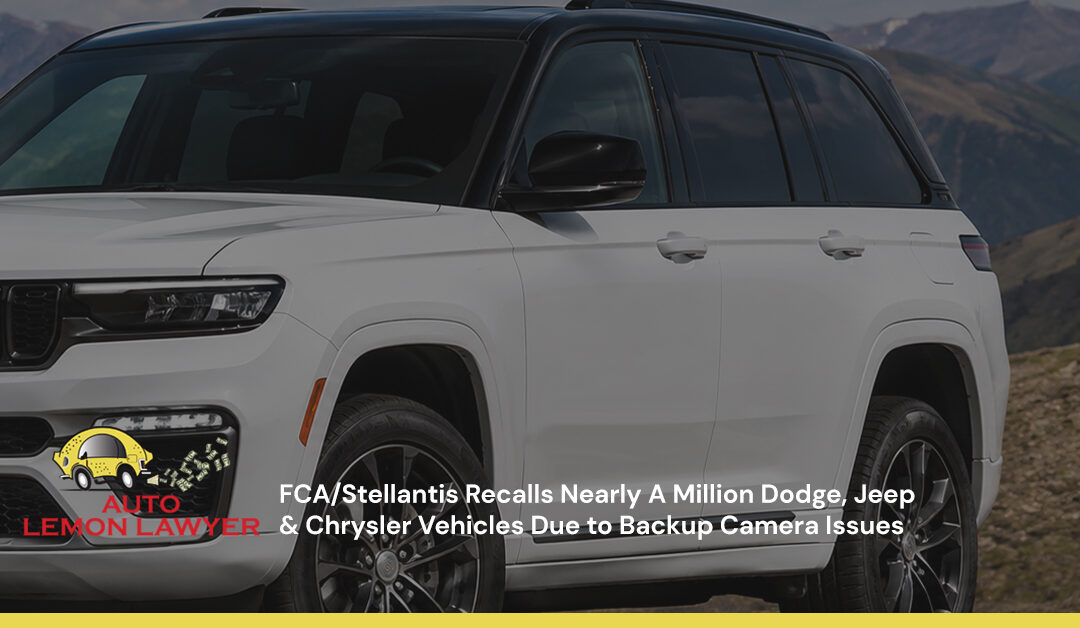
FCA US LLC, part of Stellantis, has announced a massive new safety recall affecting roughly 955,000 Chrysler, Dodge, Jeep and Ram vehicles worldwide after discovering that a software problem may prevent the rearview camera image from appearing when drivers shift into reverse.
Approximately 848,511 vehicles are affected in the United States, with additional vehicles recalled in Canada, Mexico and other international markets. Stellantis says the problem involves the vehicle’s radio software rather than the backup camera hardware itself.
Although Stellantis says it is not aware of any crashes or injuries associated with the defect, the failure of a backup camera can create a significant safety concern – particularly when drivers are backing out of parking spaces, driveways or other areas where pedestrians, children, cyclists or objects may be difficult to see.
Quick Highlights
- Stellantis is recalling roughly 955,000 vehicles globally, including 848,511 in the United States.
- The recall affects certain 2026 and 2027 Chrysler, Dodge, Jeep and Ram vehicles.
- Faulty radio software can prevent the rearview camera image from appearing on the vehicle’s media screen.
- Stellantis says there may be no advance warning before the camera image fails.
- The manufacturer plans to correct the problem primarily through a free over-the-air software update.
- Owners are expected to begin receiving recall notices in September 2026.
- A recall by itself does not automatically make a vehicle a lemon, but repeated camera failures or unsuccessful repairs could potentially contribute to a Lemon Law or warranty claim.
What Is Causing the Stellantis Backup Camera Recall?
Unlike some rearview camera recalls caused by defective cameras, wiring or other physical components, this recall involves the software used by the vehicle’s radio and infotainment system.
According to FCA, the software may prevent the rearview camera image from displaying on the media screen after the vehicle is placed into reverse. Importantly, the company says the condition may occur without any advance warning to the driver.
That means a driver could shift into reverse expecting the normal camera view, only to find that the image does not appear.
The defect is significant because rearview cameras are required under federal vehicle safety standards. A missing rearview image reduces a driver’s ability to identify people, vehicles or objects located directly behind the vehicle and can increase the risk of a backing collision.
Which Chrysler, Dodge, Jeep and Ram Vehicles Are Recalled?
The recall primarily involves newer 2026-model-year vehicles, along with certain 2027 Chrysler and Dodge models.
Affected vehicles include:
- 2026–2027 Chrysler Pacifica
- 2026–2027 Chrysler Pacifica Plug-In Hybrid
- 2026–2027 Chrysler Voyager
- 2026–2027 Dodge Charger
- 2026 Jeep Cherokee
- 2026 Jeep Compass
- 2026 Jeep Gladiator
- 2026 Jeep Grand Cherokee
- 2026 Jeep Grand Cherokee L
- 2026 Jeep Grand Wagoneer
- 2026 Jeep Grand Wagoneer L
- 2026 Jeep Wrangler
- 2026 Ram 1500
- 2026 Ram 2500
- 2026 Ram ProMaster
- 2026 Ram ProMaster EV
Because recalls are typically based on specific production dates, components and vehicle identification numbers, owning one of the models above does not necessarily mean your individual vehicle is included.
Beginning August 20, 2026, owners can enter their VIN into Stellantis’ Mopar recall lookup system to determine whether their vehicle is affected by the campaign. FCA identifies the campaign as Recall 78D.
How Many Vehicles Are Affected?
The U.S. portion of the recall covers approximately 848,511 vehicles.
Stellantis has also identified approximately:
- 82,869 vehicles in Canada;
- 7,969 vehicles in Mexico; and
- more than 15,000 vehicles in other international markets.
That brings the worldwide total to approximately 955,000 vehicles.
The enormous size of the recall is particularly notable because the affected vehicles are almost entirely from the newest model years.
Why Is a Failed Backup Camera a Safety Concern?
Backup cameras have become such a familiar part of modern driving that many motorists depend heavily on them when reversing.
The system is particularly valuable for detecting objects or people in areas that may be difficult or impossible to see through traditional mirrors alone. According to Reuters, federal regulators required rearview cameras on new light-duty vehicles beginning in 2018 as part of an effort to reduce backover crashes.
A camera that unexpectedly fails to display can therefore create more than an inconvenience.
Drivers could have difficulty seeing:
- Small children behind the vehicle;
- Pedestrians crossing a driveway or parking aisle;
- Bicycles or scooters;
- Shopping carts or other low objects;
- Parked vehicles;
- Posts, walls or other obstacles.
Until the software remedy has been installed, Stellantis advises drivers whose camera image does not appear to remain aware of their surroundings and rely on their rearview and side mirrors when backing up.
How Will Stellantis Fix the Backup Camera Problem?
The good news for many affected owners is that the recall repair should not require replacing the actual camera.
Stellantis plans to provide an over-the-air radio software update across the affected brands. When the update becomes available, owners should receive a notification on their vehicle’s media screen asking them to accept and install the update.
FCA says the over-the-air remedy is expected to become available in September 2026. Owners who successfully install the update remotely should not need to visit a dealership specifically for the recall. Those who have trouble completing the update can contact a dealer or FCA customer care for assistance.
Recall notification letters are also expected to begin arriving in September.
What Should Owners of Recalled Stellantis Vehicles Do?
If you own one of the affected Chrysler, Dodge, Jeep or Ram vehicles, you should first check your VIN to determine whether your specific vehicle is included in Recall 78D.
If it is, watch for the software-update notification and complete the update as soon as it becomes available.
Owners should also pay attention to how their vehicle behaves before and after the repair. If the rearview camera has already failed – or continues to fail after the recall update – it can be helpful to document the problem.
Consider keeping:
- Copies of recall notices;
- Dealership repair orders;
- Dates when the camera failed;
- Photos or video showing the blank or missing camera image;
- Records of software updates;
- Communications with the dealership or manufacturer; and
- Documentation of any additional electrical or infotainment problems.
Even when a dealership says that it cannot reproduce a problem, make sure your complaint is accurately written on the repair order.
Does a Backup Camera Recall Mean Your Vehicle Is a Lemon?
Not necessarily.
A safety recall alone does not automatically make a vehicle a lemon. Manufacturers are generally permitted an opportunity to repair covered defects.
However, the existence of a recall can become relevant if your vehicle continues experiencing the same defect after the manufacturer has attempted to repair it.
For example, an owner may have a stronger potential warranty or Lemon Law claim when:
- The backup camera repeatedly fails;
- The software update does not permanently correct the problem;
- The vehicle returns to the dealership multiple times for the same complaint;
- Related infotainment or electrical problems continue occurring;
- The dealership repeatedly says it cannot duplicate the defect; or
- The vehicle spends an extended amount of time out of service.
Auto Lemon Lawyer notes that recalls, recurring defects, multiple unsuccessful repair attempts, safety concerns and detailed repair records can all be important when evaluating a potential warranty or Lemon Law claim.
California Lemon Law and Repeated FCA/Stellantis Problems
For qualifying vehicles in California, the Song-Beverly Consumer Warranty Act generally requires manufacturers to repair warranty-covered defects within a reasonable number of opportunities. If the manufacturer cannot bring the vehicle into conformity with its express warranty after a reasonable number of attempts, the consumer may potentially be entitled to a replacement vehicle or repurchase, depending on the circumstances.
Whether a particular Chrysler, Dodge, Jeep or Ram qualifies depends on factors such as the vehicle’s warranty status, repair history, nature of the defect, number of repair opportunities and amount of time the vehicle has spent out of service.
Because Lemon Law requirements vary by jurisdiction and individual circumstances, owners should not assume that either receiving – or completing – a recall automatically determines whether they have a claim.
Still Having Backup Camera or Other Problems With Your Stellantis Vehicle?
The new Stellantis backup camera recall is intended to correct the software problem through a free update. But for some owners, a recall may be only one part of a longer history of electrical, infotainment or safety-related problems.
If your Chrysler, Dodge, Jeep or Ram has experienced recurring backup camera failures, repeated unsuccessful repairs, excessive dealership visits or other warranty defects that have not been properly resolved, Auto Lemon Lawyer can review your repair history and help determine whether you may have rights under applicable Lemon Law or warranty protections.
Contact Auto Lemon Lawyer today for a free case evaluation.

Lucas graduated cum laude from Southern University Law Center in 2025, finishing second overall in his graduating cohort. He was a recipient of the Southern University Law Center Merit Scholarship, awarded to students in the top five percent (5%) of the class based on merit, academic performance, and character. Lucas is admitted to practice law in the State of Louisiana. While his time in formal legal practice is recent, he has been part of the Auto Lemon Lawyer team for over five years, during which he has worked in every position within the firm. This experience provides him with a comprehensive understanding of Lemon Law cases from intake through litigation and resolution.