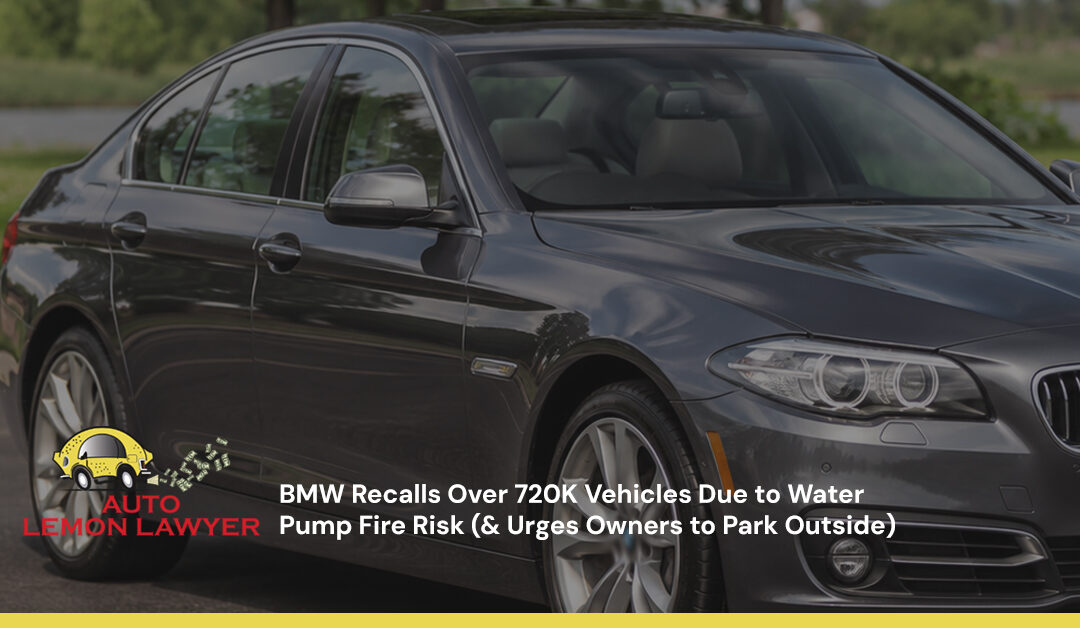
BMW is recalling 720,796 vehicles in the United States because a problem involving the electric water pump connector could cause a short circuit and potentially start a fire – even while the vehicle is parked and turned off.
Because of the potential fire risk, the National Highway Traffic Safety Administration (NHTSA) has issued an unusually strong warning to affected BMW owners: park your vehicle outside and away from buildings and other vehicles until it has been repaired.
Adding to the concern, these same vehicles were previously recalled in 2024 for a related water pump issue. According to NHTSA, vehicles that received the earlier recall repair will need to be repaired again under the new campaign.
Quick Highlights
- BMW is recalling 720,796 vehicles because an electrical connector at the water pump may allow moisture to enter and cause a short circuit.
- The short circuit can increase the risk of a thermal event or vehicle fire, including while the BMW is parked and turned off.
- NHTSA is telling affected owners to park outside and away from buildings and other vehicles until the recall repair is completed.
- The recall includes certain 2012–2018 BMW 2 Series, 3 Series, 4 Series, 5 Series, X1, X3, X4, X5 and Z4 vehicles.
- The vehicles were previously recalled for a related water pump problem in 2024, but they now require another repair.
- BMW is aware of approximately 10 U.S. incidents that relate, or may relate, to the problem, all involving vehicles that had received the previous recall remedy.
- BMW says it is not aware of any crashes or injuries connected to the current issue.
- A final repair for the new recall is still being developed and will be performed free of charge when available.
- Owner notification letters are expected to begin mailing December 25, 2026.
Which BMW Vehicles Are Included in the Recall?
The recall covers a wide range of BMW cars and SUVs produced during the 2012 through 2018 model years.
According to NHTSA, affected models include:
- 2012–2016 BMW 3 Series
- 2012–2016 BMW 5 Series
- 2012–2015 BMW X1
- 2012–2016 BMW Z4
- 2013–2017 BMW X3
- 2014–2016 BMW 2 Series Coupe
- 2014–2016 BMW 3 Series Sportswagon
- 2014–2016 BMW 328xi Gran Turismo
- 2014–2016 BMW 4 Series Convertible
- 2014–2016 BMW 4 Series Coupe
- 2015–2016 BMW 2 Series Convertible
- 2015–2016 BMW 4 Series Gran Coupe
- 2015–2018 BMW X4
- 2016–2018 BMW X5 xDrive40e
In total, BMW estimates that 720,796 vehicles are potentially involved in NHTSA Recall 26V733.
Not every BMW from these model years is necessarily included, so owners should ultimately confirm their vehicle’s recall status using its Vehicle Identification Number (VIN).
What Is Wrong With the BMW Water Pump?
The issue centers on the electrical connector for the electric water pump.
NHTSA says an improperly sealed connector may be exposed to moisture. If moisture enters the water pump connector, it can cause an electrical short circuit. That short can generate excessive heat and, in rare cases, result in a fire.
BMW’s investigation into the latest incidents went further.
According to the automaker’s safety recall report, engineers examining returned water pumps found evidence of material degradation and severe localized embrittlement involving the connector’s Polybutylene Terephthalate (PBT) material. Additional analysis identified evidence of cracks in portions of the connector.
Those cracks can potentially create a pathway for moisture to enter the pump. BMW ultimately decided on October 28, 2026, to conduct another voluntary safety recall.
Why Is NHTSA Telling BMW Owners to Park Outside?
The most concerning aspect of this recall is that the fire risk isn’t limited to times when the engine is running.
NHTSA specifically warns that an affected BMW may catch fire while parked and turned off.
As a result, owners of recalled vehicles are being instructed to park:
Outside and away from buildings, garages, homes and other vehicles until the BMW has been repaired.
BMW’s official recall filing specifically designates this as a “Park Outside” recall. The filing does not classify the vehicles under a “Do Not Drive” advisory, but the parking precaution should be taken seriously because a fire could occur after the vehicle has been shut off.
Owners should follow BMW and NHTSA’s instructions rather than continuing to park an affected vehicle inside an attached garage while waiting for the recall remedy.
Haven’t These BMWs Already Been Recalled for This Problem?
Yes – and that is one of the most significant aspects of the new recall.
In August 2024, BMW recalled the same population of approximately 720,796 vehicles under NHTSA Campaign 24V608 because an improperly sealed electrical connector at the water pump could become exposed to fluid and short circuit.
The previous repair involved installing a protective shield intended to divert residual fluid from the engine’s positive crankcase ventilation system away from the water pump’s electrical connector.
Dealers were also instructed to inspect the electrical connector and wiring harness and, when necessary, replace the pump and/or wire harness.
However, BMW subsequently began receiving reports of thermal incidents in vehicles that had already undergone the recall repair.
What Happened After the 2024 BMW Recall?
BMW’s latest recall report provides a timeline showing how the company discovered the original remedy might not fully address the problem.
In April 2025, BMW learned of a non-U.S. BMW 5 Series that experienced a thermal overload at the water pump connector even though the vehicle had already received the 2024 recall remedy.
Then, in June 2025, BMW became aware of a U.S. BMW 3 Series that experienced smoldering at the water pump’s electrical connector after receiving the previous recall repair.
By early 2026, BMW identified additional incidents involving previously repaired vehicles experiencing overheating or thermal overload at the pump connector. The company subsequently began examining returned pumps to determine why the condition could still occur.
Testing during 2026 eventually revealed substantial deterioration of material in portions of the electrical connector. BMW’s investigation included laboratory analysis, microscopic examination, chemical analysis and even CT scanning of affected components.
BMW Knows of Approximately 10 Potentially Related U.S. Incidents
As of the decision to conduct the latest recall, BMW reported approximately 10 U.S. field incidents that relate, or may relate, to the defect.
NHTSA says those incidents occurred in vehicles that had already been repaired under the earlier recall.
Fortunately, BMW has reported no known crashes or injuries associated with the issue.
While BMW estimates that the actual percentage of recalled vehicles containing the defect is less than 0.1%, the potential consequences are serious enough that the entire affected population is being recalled and owners are being instructed to park outdoors until repairs can be completed.
What Is BMW’s Repair for the New Recall?
For now, BMW is still developing the final remedy.
NHTSA says the eventual repair will be performed free of charge at BMW dealerships once it becomes available.
This means owners may receive notice of the recall before a dealer is actually able to perform the permanent repair.
Until the repair is completed, NHTSA’s instruction remains clear: owners of affected vehicles should park outside and away from buildings and other vehicles.
Owner notification letters are expected to begin mailing on December 25, 2026.
How Can BMW Owners Check Their Vehicle?
Owners can determine whether their vehicle is affected by searching their VIN through NHTSA’s recall database.
However, NHTSA says VIN and license-plate information for this particular campaign is expected to become searchable beginning December 25, 2026.
BMW owners can also contact BMW’s recall hotline at 800-525-7417.
Owners can reach NHTSA’s Vehicle Safety Hotline at 888-327-4236.
When speaking with BMW or a dealership, affected owners should reference NHTSA Recall 26V733.
What Should You Do If Your BMW Was Already Repaired Under the 2024 Recall?
If your BMW received the previous recall repair, do not assume the vehicle is no longer affected.
NHTSA specifically states that vehicles repaired under the 2024 recall must be repaired again.
Owners should also maintain complete documentation related to both recall campaigns.
Keep copies of:
- Recall notification letters;
- Dealership repair orders;
- Records from the original 2024 recall repair;
- Records of any water pump or electrical repairs;
- Tow bills or rental vehicle expenses;
- Photographs or videos of smoke, melting, burning smells or visible damage;
- Communications with BMW or the dealership; and
- Documentation showing how many days the vehicle was unavailable because of repairs.
Your repair history can become particularly important if the vehicle continues experiencing problems after repeated attempts to correct the same defect.
Does a BMW Recall Automatically Make the Vehicle a Lemon?
No. A safety recall by itself does not automatically establish that a vehicle qualifies as a lemon.
Lemon Law and warranty claims depend on the facts surrounding the individual vehicle, including its warranty coverage, repair history, number of repair attempts, seriousness of the defect and amount of time the vehicle has spent out of service.
However, a serious safety defect that continues after repair attempts can be highly relevant when evaluating a potential warranty claim.
Auto Lemon Lawyer explains that factors such as repeated failures, multiple repair attempts, defect severity, safety concerns and days out of service can affect a consumer’s potential claim. The firm’s guidance also notes that even when a dealership says it cannot duplicate an intermittent problem, repeated documented repair attempts can still help establish that an ongoing defect exists.
The circumstances surrounding this BMW recall are particularly notable because the new campaign applies to vehicles that were already recalled and repaired for a related water pump concern.
Having Repeated Problems With Your BMW?
For many BMW owners, the eventual recall repair may resolve the water pump problem.
But if your BMW has experienced repeated electrical problems, water pump failures, overheating, burning smells, smoke, unsuccessful recall repairs or significant time in the repair shop, your repair history may warrant a closer look.
The fact that BMW is recalling more than 720,000 vehicles for a second time does not automatically make every affected vehicle a lemon. But owners who continue experiencing unresolved warranty defects after giving the manufacturer opportunities to repair them may have rights under applicable state Lemon Laws or federal warranty laws.
Auto Lemon Lawyer can review your BMW’s repair history, warranty records and dealership documentation and help determine what legal options may be available.
If your BMW has been repeatedly repaired for the same problem or continues experiencing unresolved warranty defects, contact Auto Lemon Lawyer for a free case evaluation.

Lucas graduated cum laude from Southern University Law Center in 2025, finishing second overall in his graduating cohort. He was a recipient of the Southern University Law Center Merit Scholarship, awarded to students in the top five percent (5%) of the class based on merit, academic performance, and character. Lucas is admitted to practice law in the State of Louisiana. While his time in formal legal practice is recent, he has been part of the Auto Lemon Lawyer team for over five years, during which he has worked in every position within the firm. This experience provides him with a comprehensive understanding of Lemon Law cases from intake through litigation and resolution.