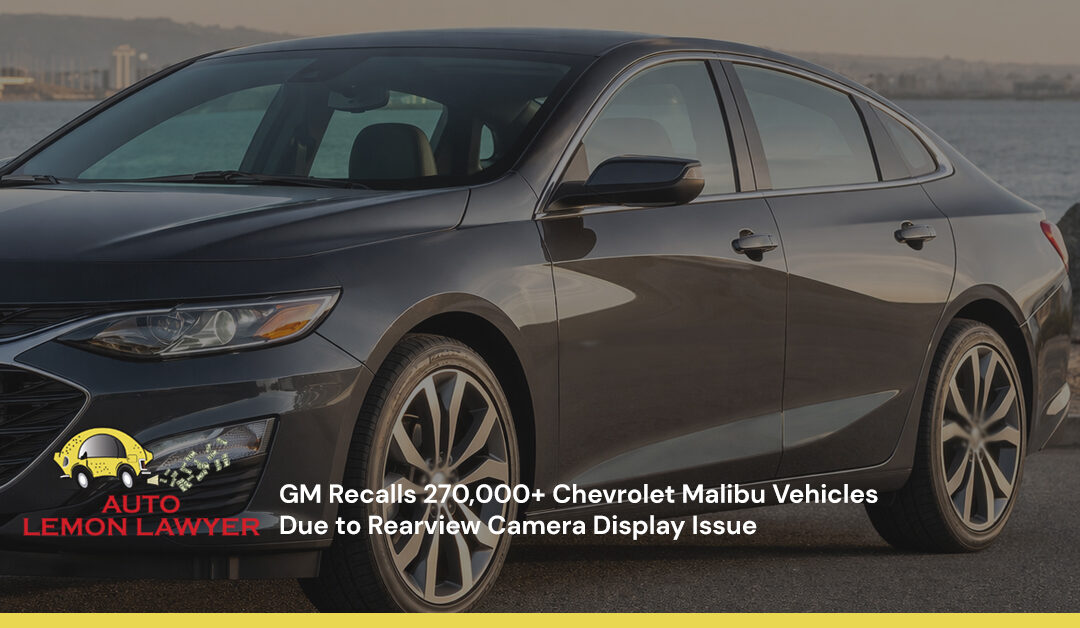
General Motors (GM) has issued a major safety recall impacting more than 271,000 Chevrolet Malibu vehicles across the United States due to a defect affecting rearview camera performance. The issue – linked to distorted or blank camera displays – raises serious safety concerns and could put drivers at risk when backing up.
For consumers, especially those already experiencing camera malfunctions, this recall highlights yet another example of how vehicle defects can impact everyday safety—and potentially trigger lemon law claims.
Vehicles Affected by the Recall
According to the National Highway Traffic Safety Administration (NHTSA), the recall (No. 26V212) affects the following models:
| Model Year | Production Dates | Vehicles Affected |
| 2023 Chevrolet Malibu | May 26, 2022 – Aug 3, 2023 | 114,755 |
| 2024 Chevrolet Malibu | Mar 22, 2023 – Jul 18, 2024 | 114,706 |
| 2025 Chevrolet Malibu | Apr 16, 2024 – Dec 20, 2024 | 42,309 |
| Total | — | 271,770 vehicles |
These figures are based on GM’s manufacturing records submitted in the official NHTSA safety recall report.
What’s the Problem?
The recall stems from a defective rearview camera system that may display:
- A distorted image, or
- A blank (non-functioning) screen
This failure can significantly reduce rear visibility when reversing.
Why This Is Dangerous
Rearview cameras are federally required under U.S. safety standards. When they fail:
- Drivers may not see pedestrians, objects, or vehicles behind them
- The risk of backover accidents increases
- The defect may violate federal safety regulations for visibility
As noted in the recall filing, reduced rear visibility “increases the risk of a crash during a backing event.”
What Caused the Defect?
The issue traces back to a supplier manufacturing defect involving Sharp Electronics, which produced the camera units.
Key findings from GM’s investigation:
- A faulty bonding process weakened the camera housing seal
- The Malibu’s camera mounting design exposed it to moisture intrusion
- Over time, moisture could penetrate the housing and damage the camera system
This combination of design and manufacturing flaws led to widespread failures in the field.
Complaints & Investigation Timeline
- GM reviewed field data over a six-month investigation period
- The company identified 19,117 complaints related to rearview camera issues
- Reports were logged between November 2022 and January 2026
- GM ultimately approved the recall on March 26, 2026
Despite the high number of complaints, GM reported no known crashes or injuries tied to this defect at the time of the recall.
Recall Remedy: What Owners Should Do
GM has outlined the following fix:
- Dealers will replace the rearview camera at no cost to the owner
- Replacement parts are sourced from outside the defective production window
- Owner notification letters are expected to begin mailing on May 18, 2026
Steps for Vehicle Owners
If you own a 2023–2025 Malibu:
- Check your VIN on the NHTSA website or GM recall page
- Watch for official recall notification letters
- Schedule a service appointment with your local dealership
- Avoid relying solely on your camera if it shows signs of malfunction
Could This Be a Lemon Law Case?
While recalls provide a repair solution, they don’t always resolve the issue permanently. If your Chevrolet Malibu has experienced:
- Repeated rearview camera failures
- Multiple repair attempts without a fix
- Extended time out of service
You may have grounds for a lemon law claim.
This latest GM recall underscores a growing trend: technology-driven defects in modern vehicles are becoming more common – and more disruptive. A seemingly small issue like a backup camera failure can have serious safety implications and legal consequences.
If you’re dealing with ongoing problems in your Chevrolet Malibu, it’s worth exploring your rights. The team at Auto Lemon Lawyer can help evaluate your case and determine whether you qualify for compensation under state lemon laws.
Need help with a defective vehicle? Contact Auto Lemon Lawyer today for a free consultation and find out if you’re entitled to a refund, replacement, or cash settlement.

Lucas graduated cum laude from Southern University Law Center in 2025, finishing second overall in his graduating cohort. He was a recipient of the Southern University Law Center Merit Scholarship, awarded to students in the top five percent (5%) of the class based on merit, academic performance, and character. Lucas is admitted to practice law in the State of Louisiana. While his time in formal legal practice is recent, he has been part of the Auto Lemon Lawyer team for over five years, during which he has worked in every position within the firm. This experience provides him with a comprehensive understanding of Lemon Law cases from intake through litigation and resolution.